________________________________________

Got something to say! We hope so!
Just click the word 'comment' at the bottom of any post.

Saturday, October 8, 2011

Regarding Open On-line Government

"... The internet is not an end in itself, but a tool. Established (political) parties haven't realised this but younger people who started life with the internet do. They want politics to change - to Politics 3.0 if you like - so politicians talk with them, not about them."

Ben de Biel
Documentary Photographer
Spokesman for the Pirate party in Germany
(which just won 9 per cent of the vote -- 15 seats -- in elections to Berlin's state parliament.)

As reported by: Nora Schultz, New Scientist Magazine, 04 October 2011, issue 2832

Issue 2832 of New Scientist magazine
© Copyright Reed Business Information Ltd

Friday, September 23, 2011

Public Display of Disaffection

"As ‘cell-fishness’ hits an all-time high, a backlash against mobile devices includes outright bans."


Public display of disaffection
Zero Creatives/Getty Images


I recently took a fresh look at Macleans Magazine, a publication I've often given short-shrift over the years. This time I was pleasently surprised. Among the several articles I found both interesting and useful in the September 19, 2011 edition was this sensitive and timely nugget by Anne Kingston and Alex Ballingall profiling the cultural and political nips and tucks of public PDA etiquette.

"A recent survey by consumer electronic site Retrevo found 10 per cent of people under age 25 didn’t see anything wrong with texting during sex."

Here's a link: Public display of disaffection - Life - Macleans.ca

Saturday, September 17, 2011

The Future of Mobile Devices

Soothsayer David Neale was, until very recently, Vice President of Special Projects at Research in Motion: this after a brief stint with Telus and a long-standing, affair with Rogers Wireless.

Now President at Neale and Associates he has much to say about the future of human connectivity and the use of personal devices.

This February 2011 audio interview with Nora Young from CBC's 'Spark' is no exception -- including a very succinct positioning of the tablet in the human rush toward all things digital.

David Neale illustration - CBC Spark

Sunday, September 11, 2011

Mobile Operators Will Lose Voice Services...


The world changes fast, as Android, iOS, RIM, and maybe even WinX, become our environments (mobile platforms) of choice. This short article explains. (Link Below).

"This future is inevitable, and the changes are coming very soon. With mobile platform providers running the show today, carriers simply have no way of stopping the process. "

"Let’s face it, the only two things that still connect carriers to consumers are the voice number and billing for the network access."

Here's the link:

Mobile operators will lose voice services to mobile platforms — Mobile Technology News:

Saturday, September 10, 2011

Are apps the evil twins of e-books?


"Apps allow interactive content, but lock readers into a platform that may disappear."

An interesting, enlightening and, thankfully, short comment from one of this planet's most mainline experts in paleoanthropology, genetics and evolution -- of all things! It's worth the effort. Here's the link;

Are apps the evil twins of e-books? | john hawks weblog:
Thu, 2011-09-01 23:31 -- John Hawks

Tuesday, August 30, 2011

First Googerola Fallout?

Samsung, a major Android partner, appears to be hedging...

...evidenced bythe company's announcement today of three new, non-Android, handsets as a lead-up to IFA Berlin -- Europe's premier consumer electronics trade show opening Friday.

Based upon Samsung's own Bada OS, the three new Wave phones boast NFC connectivity and several other innovative new features.

Could this signal a move away from Android? More likely, a shot across Googerola's bow:

'Watch it Google, we do have options!'

Monday, August 29, 2011

Apple Killer?

Here's an interesting take on the Googerola wars -- from the Globe & Mail too! Imagine: Give it a read!

"... it’s a throwback to a battle over personal computers that Apple found itself involved in – and ultimately lost – 25 years ago."


© 2011 CBS Interactive

Here's the link: Tech News - The Globe and Mail

Wednesday, August 24, 2011

The Internet's Dark Underbelly


"There is a dark underbelly to the diversity of content and services that the internet has brought us, ... "

... one that leaves it more vulnerable to centralization, not less. The Internet with its uniquely open design has led to a moment when all other information networks have converged upon it as the one "superhighway," to use the 1990s term. While there were once distinct channels of telephony, television, radio, and film, all information forms are now destined to make their way increasingly along the master network that can support virtually any kind of data traffic. This tendency, once called "convergence," was universally thought a good thing, but its dangers have now revealed themselves as well. With every sort of political, social, cultural, and economic transaction having to one degree or another now gone digital, this proposes an awesome dependence on a single network, and a no less vital need to preserve its openness from imperial designs."

From:
The Master Switch : The Rise and Fall of Information Empires,
Copyright © 2010 by Tim Wu, pg 318

Tuesday, August 23, 2011

'Heads' Up!!

Tablets becoming popular bathroom activity, survey finds. (Network World)

"30% also report using tablets at restaurants"

"With the market flush with hot-selling tablet computers, it shouldn't bowl anyone over to learn that many users are taking the plunge and bringing their devices to the bathroom."

Saturday, August 20, 2011

Navigating Convergence: Charting Canadian Communications Change and Regulatory Implications

"An ongoing point of debate among analysts, consumers and stakeholders is the degree to which regulation is needed to foster sustainable competition." - CRTC

Hot Off The Presses! This new report from the Canadian Radio-television and Telecommunications Commission (CRTC) provides in-depth analysis of many of the trends, opportunities and challenges facing the Canadian telecommunications and broadcasting industries going forward. More specifically, the report:
  • Examines the evolution of networks, including both fixed and mobile.
  • Considers the impact of convergence on consumer behaviours and the associated challenges with the creation of Canadian content, and
  • Outlines challenges and opportunities faced by consumers in this rapidly changing and increasingly complex world of convergence.
  • Provides follow-up to the 2010 report of the same name. 
Here's the link to the HTML version:
Navigating Convergence: Charting Canadian Communications Change and Regulatory Implications:

PDF Version: HERE

Says It All

"Wonder When My Motorola Xoom Will Arrive?"

Friday, August 19, 2011

2011 Second Quarter Smartphone Sales

"Hewlett-Packard Co.’s webOS barely registers and is listed under “Others.”

For those who really, really care: Gartner's latest worldwide smartphone marketshare numbers published this morning by the Washington Post.

HINT: Apple is number three -- by a mile!

Here's the link:
Second-quarter smartphone sales by operating system - The Washington Post:

Thursday, August 18, 2011

Brain-like Processors ...

Prototype Cognitive Computing Chip
"Today, IBM researchers unveiled a new generation of experimental computer chips designed to emulate the brain’s abilities for perception, action and cognition."

Connected or what?
(And why am I hearing the theme from ...
The Twilight Zone?)

Here's a link:
IBM Unveils Cognitive Computing Chips - HotHardware:

Tuesday, August 16, 2011

Springsteen and Others Soon Eligible to Recover Song Rights - NYTimes.com

"When copyright law was revised in the mid-1970s, musicians, like creators of other works of art, were granted “termination rights,” which allow them to regain control of their work after 35 years,"

Wow! Complex or what? Who ever said copyright was easy?

The New York TimesNever one to fall asleep at the switch, once again the new York Times comes up with information that is not just entertaining, but useful!! An intriguing article for anyone who writes and/or performs anything.

Here's the link:
Enhanced by Zemanta

Monday, August 15, 2011

Google Acquiring Motorola Mobility

Big surprise! Smart move? BIG numbers! I'm sure you've heard the news: $12.5 billion (Google's largest-ever deal). 17,000 existing patents with 7,000 more in process (no tough feelings over the Nortel deal, I guess). Perhaps we should have seen something coming back in January when Motorola split in two ('Mobility' and 'Solutions').

© 2011 CBS Interactive
Here are links to the official releases:

Google Investor Relations Announcement.

Google Blog - Letter from CEO Larry Page.

Motorola Mobility Release.

Business Insider- Early Analysis.

Early thoughts on the matter? This will greatly expand Google's hardware footprint and perhaps decrease Far East dependence by bringing the bulk of design and manufacturing home.

The deal will free Motorola to focus on what it does best - business and mission-critical communication communications products and services.

Sunday, August 14, 2011

Near-Field Communications and Smartphones


"The biggest problem confronting NFC is practical: It may require new phones as well as new point-of-sale terminals, plus software that serves up targeted offers. It’s the mother of all chicken-and-egg scenarios,"

NOT just another article about smartphones!

In this lengthy, insightful, and entertaining, article Bloomberg Businessweek's Brad Stone and Olga Kharif provide a wealth of information:
  • an understandable introduction to Near-Field Communications (NFC)
  • a good look at new-tech development cycles
  • a peek at life inside a small sliver of the payments world
  • a great bit of recent history
  • a heads-up into what Google, Visa, Mastercard, Square, Apple, Nokia, RIM and many other leading-edge players are working on.
  • it's also an entertaining read.
HERE'S THE LINK:

Thursday, August 11, 2011

Ford Considers Mesh Wi-Fi Car Network

"Existing in-car systems currently use established wireless broadband networks, but Ford is considering embedding vehicles with technology turning each car into part of a massive Wi-Fi mesh network."

Should have seen it coming! For years now the developing standard for next-generation Intelligent Transport Systems (ITS) has envisioned roadside APs every several hundred yards along all transportation corridors. Mesh technology could bring a lot to the party -- at least in an urban environment.

Here's the link: Mobile Mesh. DSLReports.com

And a heads-up for those with the ITS bug: A Joint ISO/ITU Workshop on Standards on ITS Communications will take place on 24 August 2011 in Kyoto, Japan

Tuesday, August 9, 2011

Something New for The Cloud.

Microsoft Demonstrates Practical Homomorphic Computing

Slashdot - Posted by timothy on Tuesday August 09, @08:08AM
Cloud
"Homomorphic computing makes it possible to compute with encrypted data and get an encrypted result, something that could make cloud services more secure.

"Such systems have so far been mathematical proofs, but researchers at Microsoft now say that stripped down versions able to only compute certain mathematical functions are efficient enough to be used today. They built prototype software capable of calculating statistical functions using encrypted data and say it could be used for processing medical data while protecting privacy."

More in-depth information here.

Monday, August 8, 2011

Huawei - How You Say???

It is possible that today's single largest technology conundrum is how to pronounce that interesting Chinese name:

Huawei Technologies Co. Ltd.
and it's subsidiaries etc

Huawei
A quick Web search provides several answers. Here's the definitive one, right from the horse's mouth:


But take note: The 'H' is almost silent -- "hWa-Way". And each of the two syllables has equal emphasis.

Click the "Hwa-way" link above (should you desire confirmation). It points to the company's corporate information page. Once there, click the embedded video. The official pronunciation is used several times.

Xris

Saturday, August 6, 2011

A Telling Cartoon

Thanks to J. David for sending this one...

Mike Luckovich© 2010 The Atlanta Journal-Constitution, 6:55 pm March 18, 2010

Thursday, August 4, 2011

The End of Plain Old Telephone Service?

"... the Australian telecommunications giant Telstra late last month released its plan to bring a close to the old telephone world. Telstra announced it will decommission its copper customer access network and stop offering fixed line telephone service to retail customers after July 1, 2018."

Hot off the presses: This short Network World column broaches the idea of life without copper telephone networks. The U.S. is reportedly heading there. Could Canada be far off? Here's the link:
Moves afoot in U.S., elsewhere to end PSTN copper lifeline:
Net Insider By Scott Bradner, Network World , August 03, 2011 11:26 AM ET

Wednesday, August 3, 2011

Interesting Facts - Global Mobile Use

The latest statistics from the International Telecommunications Union

"In 2002 there were just two countries in the world with mobile cellular penetration over 100% . Eight years later, almost 100 economies had mobile cellular penetration over 100% – and 17 economies had penetration rates above 150%"


Mobile Penetration
To see more click this link:
ITU StatShot - August 2011:

The ITU is the leading United Nations agency for information and communication technology.

Sunday, July 24, 2011

The Decade List - Douglas Reid Interview

A very entertaining and culturally important conversation.with:

Douglas Reid
Associate Professor & Distinguished Faculty Fellow in Strategy
Queen’s School of Business

In Part One Mr. Reid details his Decade List, "having a common thread that guides your life, belonging to verbs instead of nouns, and what cycling has to do with it all"

Part Two carries on about "measuring life experiences, the career ladder paradigm, and the content of your character."

Here's the link:
The Decade List - Douglas Reid Part One, Part Two

Thanks to:
with Sean Howard and Eric Portelance
A weekly podcast that explores the intersection of purpose, passion and action.

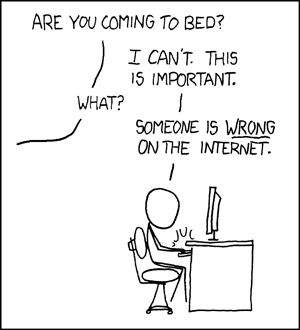
The Backfire Effect « You Are Not So Smart

An admittedly long yet very interesting article detailing how we often fall into an argument trap.

"When you read a negative comment, when someone shits on what you love, when your beliefs are challenged, you pore over the data, picking it apart, searching for weakness. The cognitive dissonance locks up the gears of your mind until you deal with it. In the process you form more neural connections, build new memories and put out effort – once you finally move on, your original convictions are stronger than ever."
by David McRaney
Source: www.xkcd.com


Here's the link: The Backfire Effect « You Are Not So Smart

Friday, July 22, 2011

Is Vegetarianism Green?

Here is an interesting exchange from the July 2, 2011 issue of New Scientist magazine: Three letters from readers addressing various aspects of the topic. The aim here is not to choose sides or sway opinions, but to illustrate just how deep such issues can be and make the point that 'common sense' is often misleading...


Hot topic
One suggestion to combat climate change is that we should become vegetarians, as livestock is more environmentally damaging than growing crops. However, if we stopped eating meat, livestock would still live, so is the suggestion correct? Or are we expected to cull any remaining pigs and cows?

Hillary Shaw, Senior lecturer and food research consultant
Harper Adams University College, Newport, Shropshire, UK

World population now stands at almost 7 billion, and is projected to level off at around 10 billion by 2050. The world currently has 17.3 million square kilometres of cultivated land; that area of land could feed 3 billion people eating mainly meat, or 42 billion people eating a strict vegan diet of mainly potatoes. For a more varied vegetarian diet, with vegetables, fruit, eggs and milk, we could feed up to 12 billion people on current world farmland and we could also eat seafood. On the negative side, these figures make no allowance for food waste or losses from disease or other disruptions to the food chain.
Farm animals produce much else besides meat, such as wool, leather, milk, cheese and eggs; so even in a vegetarian world, some animals would be retained, but far fewer. The lifespan of most farm animals is quite short, between 10 and 20 years at the most and often fewer. So without breeding, their population would fall quickly. Farm animals produce carbon dioxide but only as much as was locked up in the grass they ate. They also produce methane, another greenhouse gas, but so do rice paddies and submerged vegetation in reservoirs.
The main benefits of a vegetarian diet with respect to global warming would be a reduction in emissions from the energy used to transport meat from farm to fork:because less land is needed to grow vegetables, more food could be produced locally. However, intensive greenhousing, such as in the Netherlands, can be very energy intensive, especially as consumers insist on having many vegetables available on supermarket shelves all year round, even out of season.
The main environmental benefit from everyone going vegetarian would not be reduced global warming but less pressure on world ecosystems - terrestrial and marine - to feed 10 billion mouths. Indirectly, global warming might be reduced as less rainforest is felled, less energy devoted to food transport and less energy needed for intensive farming methods. On the "downside", we might all be healthier and less obese, so we'd live longer and world population would be increased somewhat.
------

Chris Smaje
Frome, Somerset, UK

Few livestock are kept for longer than two years before slaughter for meat, and because we farmers respond readily to the economics of supply and demand, it wouldn't be long before decreasing consumer demand for meat was reflected in smaller numbers of farm animals.
The questioner's statement that "livestock is more environmentally damaging than growing crops" begs many questions. A grass-fed suckler operation for beef, for example, produces less carbon than a similarly sized arable farm. Livestock can be integrated into vegetable-growing systems in order to reduce the amount of climate-damaging tillage and diesel use.
To farm sustainably and minimise machine tillage, farms will probably still need livestock, albeit in far smaller quantities.
-----

Jan Horton
West Launceston, Tasmania, Australia

The largest proportion of any crop is inedible for humans. All that biomass has to go somewhere, and the easy thing to do is feed it to animals that process it into meat. The sheer volume of low-grade waste is too great to process for biofuel and the cost for other forms of disposal would be massive. If it is not removed, the next crop cycle will not be able to be planted. Rotting plants produce greenhouse gasses too.
Other animals will move in, multiply hugely and deal with the biomass. They will also produce the same greenhouse gases as cattle do now. In Australia this will probably fall to rabbits, kangaroos, camels, wild pigs and buffalo.
As my university lecturer says: "Given the same area of land, you can feed a lot more people on bread and pea soup than you can on steak, but you can do it for a lot longer and with fewer problems if everyone gets bread, pea soup... and some steak." The cattle eat the pea vines and live on the pasture, which is used to rotate the wheat and pea plots. The dung and urine can fertilise the soil and humans get to eat a steak here and there.
This is a complex process without an easy solution. So don't feel guilty eating the odd steak. Just ensure it was grown largely on pasture and crop residues and not transported too far.
----

For an in-depth analysis of what would happen if we all stopped eating meat, take a look at "What's the beef with meat?", New Scientist, 17 July 2010, p 28 - Ed

Wednesday, June 8, 2011

Welcome to the Anthropocene ' The Economist"

Humans have changed the way the world works. Now they have to change the way they think about it, too


The Economist Magazine - May 26th 2011, pg 11

An insightful and refreshingly concise and comprehensive view of what's needed to really be 'green.'

Definitely worth the effort!!


(Copyright © The Economist Newspaper Limited 2011. All rights reserved.)

Wednesday, February 23, 2011

The Master Switch - A Must Read!

The Master Switch : the Rise and Fall of Information Empires by Tim Wu is an interesting and highly valuable read. Framed as an inside-looking-out history of the greatest industries of our day -- from AT&T and the American motion picture studios to the major cable and television networks -- the book details just how some of the leading characters in American business centralized control of each of those industries, identifies those seeking to do the same with the internet and provides detailed reasons why we should care.

LINK
"There is a dark underbelly to the diversity of content and services that the internet has brought us, one that leaves it more vulnerable to centralization, not less. The Internet with its uniquely open design has led to a moment when all other information networks have converged upon it as the one "superhighway," to use the 1990s term.

"While there were once distinct channels of telephony, television, radio, and film, all information forms are now destined to make their way increasingly along the master network that can support virtually any kind of data traffic.

"This tendency, once called "convergence," was universally thought a good thing, but its dangers have now revealed themselves as well. With every sort of political, social, cultural, and economic transaction having to one degree or another now gone digital, this proposes an awesome dependence on a single network, and a no less vital need to preserve its openness from imperial designs." (pg 318) *

From David Sarnoff, Adolph Zukor, and Theodore Vail, to Steve Jobs and 'The Woz,' Google, Ted Turner, the newly recentralised AT&T, and the ever-crafty motion picture studios -- all play key roles in this surprisingly captivating story of the ongoing struggle for control of all things connected.

*Copyright 2010 by Tim Wu. All rights reserved. PUBLISHED BY ALFRED A. KNOPF a division of Random House, Inc.., New York, and in Canada by
Random House of Canada Limited, Toronto


Enhanced by Zemanta

Saturday, January 22, 2011

Universal Broadband - Where's Canada?

Newsroom • ITU StatShot:


The International Telecommunications Union (ITU) in its January 5, 2011, statistics newsletter, states that; "Over 40 countries now include broadband in their universal service / universal access definitions – and in some countries broadband access has become a legal right." The listed country's are:

"Albania, Andorra, Argentina, Azerbaijan, Bahrain, Brazil, Burkina Faso, China, Colombia, Dominica, Dominican Republic, Egypt, Finland, Ghana, Grenada, Guinea, Haiti, India, Kazakhstan, Liechtenstein, Malawi, Malaysia, Mongolia, Morocco, Nepal, Nicaragua, Nigeria, Oman, Pakistan, Peru, Samoa, Saudi Arabia, Sierra Leone, Sri Lanka, Spain, Sudan, Suriname, Switzerland, Trinidad & Tobago, Uganda, United States."

Where be Canada?

Saturday, January 15, 2011

20 predictions for the next 25 years | Society | The Observer

From The Guardian - A UK Perspective:

"From the web to wildlife, the economy to nanotechnology, politics to sport, the Observer's team of experts prophesy how the world will change – for good or bad – in the next quarter of a century."

An interesting read -- whether or not you agree with the 'experts.'


Gareth Pugh show


"A hundred years ago, as Britain's dominance eroded, rivals, particularly Germany, were emboldened to take ever-greater risks. The same will happen as American power erodes in the 2010s-20s. "


Thanks to: Douglas Reid for the heads-up.